What is an order block?
Short answer: An order block is a price area where large institutional traders previously placed significant buy or sell orders, often leading to strong price moves. Traders use these zones to anticipate future reactions when price returns.
Key takeaways:
- Order blocks represent institutional buying or selling zones
- They often lead to strong price reactions when revisited
- Bullish blocks signal potential buying zones, bearish blocks signal selling zones
- They work across multiple markets and timeframes
- Confirmation improves reliability and reduces risk
What is an order block in trading?
An order block is a price zone where significant buying or selling occurred before a strong directional move. It is typically identified as the last bullish or bearish candle before a major breakout.
Order blocks are important because they help traders understand where “smart money” may enter the market again. Instead of guessing entries, traders use these zones to align with institutional activity and improve decision-making.
An order block is a price zone formed by the last consolidation or candle before a strong move, where large buy or sell orders were executed. When price revisits this area, it often reacts again, making it a key level for entries, stop-loss placement, and trend continuation trades.
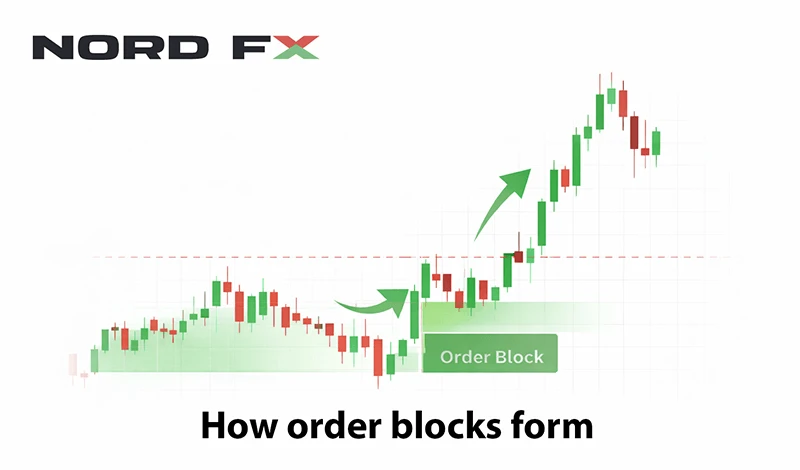
How order blocks form
Order blocks form when institutional traders accumulate or distribute positions. Because large orders cannot be executed instantly, institutions create zones of liquidity, leaving behind identifiable footprints on the chart.
For example:
- A strong upward move often starts after a bearish candle (bullish order block)
- A strong downward move often starts after a bullish candle (bearish order block)
These zones become important because price often returns to them to rebalance orders.
Why traders use order blocks
Traders use order blocks to:
- Identify high-probability entry points
- Align with institutional trading behavior
- Improve risk-to-reward ratios
- Avoid random entries
How to Find an Order Block
To find an order block, look for the last opposing candle before a strong impulsive move that breaks structure.
Step-by-step process
- Identify a strong move (impulse)
- Look at the last candle before the move
- Mark that candle’s range as the order block
- Wait for price to return to that zone
Key characteristics
- Strong momentum away from the zone
- Break of structure (higher high or lower low)
- Clear imbalance or inefficiency in price
Bearish and Bullish Order Blocks
Order blocks are classified into two main types: bullish and bearish.
Bullish order block
A bullish order block forms before an upward move. It is usually the last bearish candle before a strong rally.
Traders look to buy when price returns to this zone.
Bearish order block
A bearish order block forms before a downward move. It is usually the last bullish candle before a sharp drop.
Traders look to sell when price revisits this area.
Comparison table
Type | Formation Candle | Expected Move | Trading Action |
Bullish OB | Bearish candle | Upward | Buy |
Bearish OB | Bullish candle | Downward | Sell |
Order block trading
Order block trading involves entering trades when price returns to previously identified institutional zones. These zones represent areas where large market participants have already shown interest, making them potential points for future reactions.
Core idea
Instead of chasing price after a strong move, traders wait patiently for the market to retrace into an order block. This approach is based on the idea that institutional orders are often not fully filled during the initial move. As a result, price may return to these zones to complete remaining orders.
When price revisits an order block, traders anticipate one of two outcomes: either a continuation of the original move or a temporary reaction. By focusing on these areas, traders aim to align their positions with institutional activity rather than retail-driven noise.
This method encourages discipline, as it requires waiting for price to come to predefined levels instead of reacting impulsively to market movement.
How order block trading works in practice
A typical order block trade follows a structured process:
- Identify a strong impulsive move in the market
- Locate the order block that caused the move
- Wait for price to retrace into that zone
- Observe price behavior within the block
- Enter the trade with confirmation or predefined rules
For example, in an uptrend, a trader marks a bullish order block and waits for price to return. If the market shows signs of rejection, such as strong bullish candles or wicks, the trader may enter a buy position with a stop loss below the zone.
Benefits
Order block trading offers several practical advantages, especially for traders who prefer structured and rule-based approaches.
Better entries
Because trades are taken at key zones rather than during impulsive moves, entries are often closer to support or resistance. This reduces the need to chase price and improves overall timing.
Smaller stop losses
Since entries occur near the origin of a move, stop losses can be placed just beyond the order block. This allows tighter risk control compared to entering trades in the middle of a trend.
Higher reward potential
Entering at the beginning of a potential move increases the distance to the target. This improves the risk-to-reward ratio, which is essential for long-term consistency.
Improved market understanding
Order block trading encourages traders to study price action and market structure rather than relying solely on indicators. This helps develop a deeper understanding of how markets move.
Risks
Despite its advantages, order block trading also comes with risks that traders need to manage carefully.
False reactions
Not every order block will hold. Price may briefly react and then continue in the opposite direction, leading to losses if trades are entered too early.
Weak or invalid zones
Some order blocks are formed without strong institutional involvement. These weaker zones are more likely to fail, especially in choppy or ranging markets.
Lack of confirmation
Entering trades without confirmation increases the probability of failure. Relying solely on the presence of an order block without considering context can lead to inconsistent results.
Marking too many order blocks on a chart can lead to excessive trading. Not all zones are equally important, and focusing on low-quality setups reduces overall performance.
Practical considerations
To improve results with order block trading, traders often:
- Focus on higher timeframe zones for stronger signals
- Combine order blocks with trend direction
- Use confirmation signals such as engulfing candles or structure shifts
- Limit trades to high-quality setups only
- Order block trading is not about predicting every market move. Instead, it is about identifying high-probability areas where price is more likely to react and managing risk effectively when it does not.
Order block example
Consider a scenario:
- Price is moving sideways
- A strong bullish breakout occurs
- The last bearish candle before the breakout is marked
- Price later returns to this zone
- A bullish reaction occurs again
This is a typical bullish order block example.
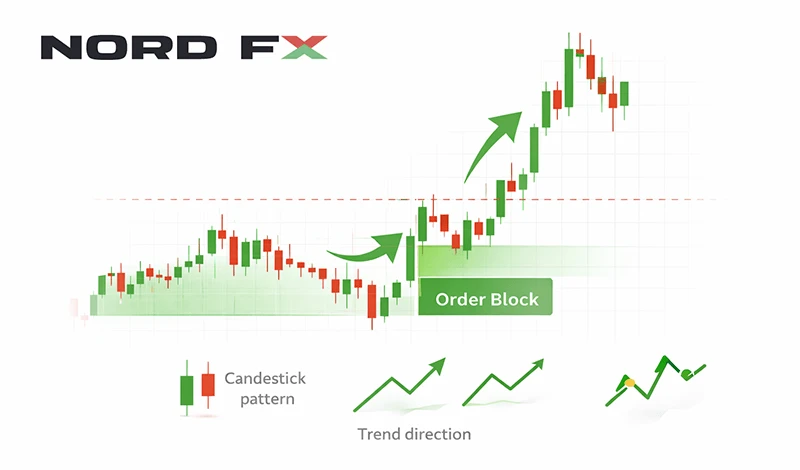
In practice, traders combine this with confirmation such as:
- Candlestick patterns
- Trend direction
- Market structure
Order block candle
The order block candle is the specific candle that defines the zone.
Characteristics of a strong order block candle
- It precedes a strong move
- It is followed by high momentum
- It often has relatively small wicks
Candle structure importance
The entire candle range (high to low) is usually considered the order block zone. Some traders refine it to:
- Body only
- Open to low (bullish)
- Open to high (bearish)
Order block trading strategy
An order block trading strategy focuses on combining order blocks with market structure, trend direction, and confirmation signals. The goal is not just to identify a zone, but to trade it within the broader context of how the market is moving.
A structured approach helps reduce impulsive decisions and improves consistency over time.
Basic strategy outline
A complete order block strategy follows a logical sequence:
Identify trend direction
Start by determining whether the market is trending up, down, or ranging. Trading in the direction of the trend increases the probability of success. For example, in an uptrend, focus only on bullish order blocks.
Locate valid order block
Mark the order block that caused a strong impulsive move and a break of structure. Avoid weak zones that formed during consolidation or low momentum.
Wait for price to return
Patience is essential. Instead of entering immediately, wait for price to retrace into the order block. This allows for better entries and lower risk.
Look for confirmation
Once price enters the zone, observe how it behaves. Confirmation can include:
- Strong rejection wicks
- Engulfing candlestick patterns
- Break of lower timeframe structure
Confirmation helps filter out false setups.
Enter trade
After confirmation, enter the trade in the direction of the original move. Some traders enter immediately after confirmation, while others wait for a minor pullback within the zone.
Set stop loss beyond the zone
Place the stop loss slightly beyond the order block. This ensures that if the zone fails, the loss is controlled.
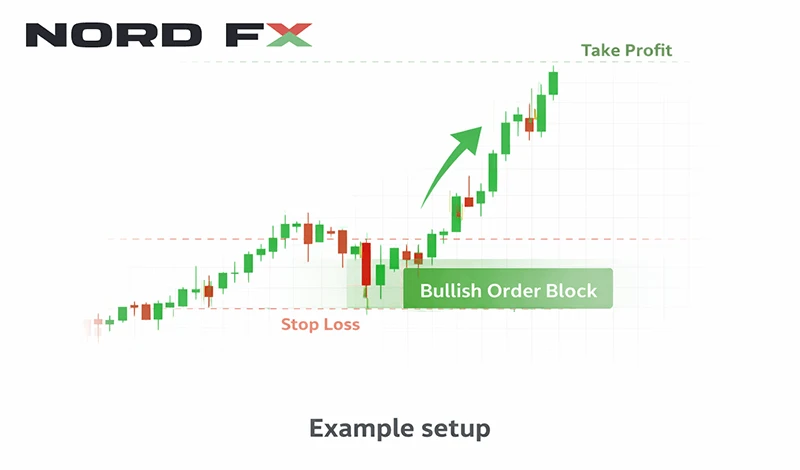
Example setup
Trend: Uptrend
The market is forming higher highs and higher lows, indicating bullish momentum.
Entry: Bullish order block
A bullish order block is identified as the last bearish candle before a strong upward breakout.
Price retraces back into this zone, showing signs of slowing down and forming rejection candles.
Stop loss: Below the block
The stop loss is placed just below the lowest point of the order block to protect against invalidation.
Take profit: Previous high or next resistance
Targets are set at logical levels, such as the previous swing high or a nearby resistance zone.
Trade flow example
A practical sequence might look like this:
- Price forms an uptrend
- A strong breakout creates a bullish order block
- Price retraces into the zone
- A bullish engulfing candle appears
- Trade is entered
- Price continues upward toward the target
Risk-to-reward planning
One of the strengths of this strategy is the ability to achieve favorable risk-to-reward ratios.
For example:
- Risk: 20 pips
- Target: 60 pips
- Risk-to-reward ratio: 1:3
This means even if only half of the trades are successful, the strategy can still be profitable over time.
Advanced considerations
As traders gain experience, they often refine the strategy further by adding:
Multiple timeframe analysis
Using higher timeframes for direction and lower timeframes for entries improves accuracy.
Liquidity concepts
Understanding where stop losses and liquidity pools exist helps anticipate price movement within the order block.
Partial entries and scaling
nstead of entering a full position at once, traders may scale into trades as confirmation develops.
Common variations of the strategy
There are different ways to apply order block trading depending on trading style:
Aggressive approach
Enter as soon as price touches the order block. This offers better entry prices but higher risk.
Conservative approach
Wait for confirmation before entering. This reduces risk but may result in slightly worse entry prices.
Hybrid approach
Combine both methods by entering partially at the zone and adding more after confirmation.
Key takeaway
An order block trading strategy is most effective when it is systematic and disciplined. The combination of trend analysis, valid zones, confirmation, and risk management creates a structured framework that can be adapted to different markets and timeframes.
How do I identify strong Order Blocks?
Strong order blocks share specific characteristics that increase their reliability.
Key signs of strength
- Strong impulse move after the block
- Break of structure
- Minimal time spent in the zone
- Clean price movement
Additional confirmation
- Alignment with higher timeframe trend
- Confluence with support/resistance
- Presence of imbalance
Which timeframes do Order Blocks work best on?
Order blocks work on all timeframes, but their reliability varies.
Timeframe breakdown
- Higher timeframes (H4, Daily): More reliable
- Mid timeframes (H1): Balanced
- Lower timeframes (M5, M15): More noise
Practical approach
Many traders use:
- Higher timeframe for direction
- Lower timeframe for entries
What markets do Order Blocks work with?
Order blocks can be applied to multiple markets.
Common markets
- Forex
- Cryptocurrencies
- Stocks
- Indices
- Commodities
Why they work across markets
Order blocks are based on institutional behavior, which exists in all liquid markets.
Best Order Block Indicators for Beginners
Indicators can help beginners identify order blocks more easily by automatically highlighting potential zones on the chart. While they simplify the process, they should be used as a learning aid rather than a complete solution.
Common tools
Supply and demand indicators
These indicators mark areas where price previously reacted strongly. While not identical to order blocks, they often overlap and can help beginners visually identify zones of interest. They are useful for spotting potential entry areas without manually analyzing every candle.
Smart money concept indicators
These tools are specifically designed to identify order blocks, liquidity zones, and market structure shifts. They often highlight bullish and bearish order blocks automatically, making them helpful for traders who are still learning how to read price action.
Volume-based tools
Volume indicators, such as volume profile or volume spikes, can provide additional confirmation. High volume near an order block may indicate strong institutional participation, increasing the likelihood of a meaningful reaction when price returns.
Important note
Indicators should assist, not replace understanding. Relying entirely on automated tools can lead to poor decision-making, especially when market conditions change.
Manual analysis helps traders:
- Understand why an order block formed
- Distinguish strong zones from weak ones
- Adapt to different market conditions
A balanced approach is to use indicators for guidance while gradually developing the ability to identify order blocks independently.
Valid Order Block: What Makes It Reliable?
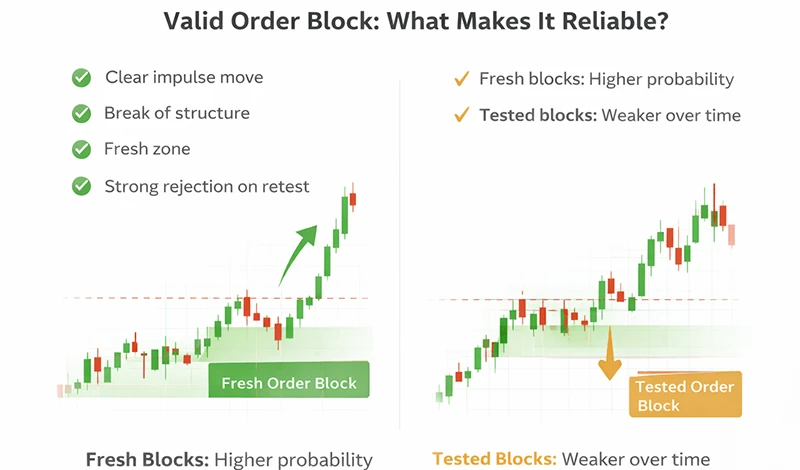
A valid order block is one that meets specific criteria and has a higher probability of holding.
Key factors
- Clear impulse move
- Break of structure
- Fresh zone (not revisited many times)
- Strong rejection on retest
Fresh vs tested blocks
- Fresh blocks: Higher probability
- Tested blocks: Weaker over time
Importance of Order Block
Order blocks provide insight into where large market participants are active.
Why they matter
- Help identify liquidity zones
- Improve timing
- Reduce emotional trading
They shift focus from indicators to price action and market behavior.
What is OB and BB trading?
OB stands for order block, while BB can refer to breaker blocks.
Differences
- Order block: Original institutional zone
- Breaker block: Failed order block that flips direction
Understanding both helps traders adapt to changing market conditions.
Is order block a good strategy?
Order block trading can be effective when used correctly.
Advantages
- Logical entry points
- Strong risk-to-reward potential
- Works across markets
Limitations
- Requires practice
- Not always accurate
- Needs confirmation
It is not a standalone solution but part of a broader strategy.
Are order block and FVG the same?
Order blocks and fair value gaps (FVG) are related but not the same.
Key differences
- Order block: Institutional order zone
- FVG: Price imbalance
They often appear together but serve different purposes.
Integrating Order Blocks into Your Trading Plan
To use order blocks effectively, they need to be part of a clear and structured trading plan rather than used randomly. A consistent approach helps you avoid emotional decisions and improves long-term performance.
Steps
Define your timeframe
Start by choosing your primary trading timeframe based on your style. For example, swing traders may use H4 or daily charts, while intraday traders may focus on M15 or H1. This determines how you identify and trade order blocks.
Identify trend
Always begin with the overall market direction. Trading order blocks in line with the trend increases the probability of success. For instance, in an uptrend, focus only on bullish order blocks and ignore counter-trend setups.
Mark key order blocks
Select only high-quality zones that led to strong moves and clear structure breaks. Avoid cluttering your chart with too many levels. Fewer, well-defined zones are more effective than marking every possible block.
Define exactly how you will enter and exit trades. This includes:
- What confirmation you require before entry
- Where you place your stop loss
- How you determine your take profit
Having clear rules removes guesswork during live trading.
Practical tip
Consistency is more important than complexity. A simple plan that you follow every time will produce better results than a complicated strategy applied inconsistently. Over time, you can refine your approach based on experience and results.
Common Order Block Trading Mistakes to Avoid
Many traders misuse order blocks, leading to losses.
Common mistakes
- Trading every order block
- Ignoring trend direction
- Entering without confirmation
- Overcomplicating analysis
How to improve
- Focus on quality setups
- Combine with structure
- Practice risk management
FAQs
What is the simplest way to identify an order block?
Look for the last opposing candle before a strong price move that breaks structure. Mark that candle’s range and wait for price to return.
Can beginners use order block trading?
Yes, but it requires practice. Beginners should start with higher timeframes and combine order blocks with basic trend analysis.
Do order blocks always work?
No. Like any trading concept, order blocks can fail. Confirmation and risk management are essential.
What is the difference between supply and demand and order blocks?
They are similar concepts. Order blocks are more specific and focus on institutional candles, while supply and demand zones are broader.
How many times can an order block be used?
The first retest is usually the strongest. Each additional test reduces its reliability.
Should I use indicators with order blocks?
Indicators can help, especially for beginners, but price action understanding is more important for long-term success.
What is the best confirmation for order block entries?
Common confirmations include engulfing candles, rejection wicks, and lower timeframe structure shifts.
Are order blocks suitable for scalping?
Yes, but lower timeframes are more volatile. Scalpers need faster confirmation and tighter risk control.
Meet the Author
Vanessa Polson is a marketing manager at NordFX with over twelve years of experience in online marketing within the financial services industry. She has developed and executed data-driven campaigns across search, social, and display channels in in-house environments. Her work focuses on translating complex financial products and trading tools into clear, practical educational content, giving her a broad and well-rounded view of the global trading landscape.
Connect with Vanessa on LinkedIn.
Повернутися Повернутися