Both MetaTrader 4 (MT4) and MetaTrader 5 (MT5) support indices trading, but they suit different trading styles. MT4 offers a simple, familiar environment that many traders appreciate, while MT5 provides additional charting tools, more timeframes, more built-in indicators, and extra analytical features. For traders who regularly analyze stock indices, MT5 generally offers a more comprehensive trading experience.
Choosing between MT4 and MT5 for indices trading is not about finding the "better" platform overall—it's about selecting the one that best fits your trading approach. Both platforms allow traders to analyze price movements, place orders, and manage risk efficiently. However, MT5 includes several enhancements that can benefit traders who rely on detailed technical analysis or trade multiple asset classes.
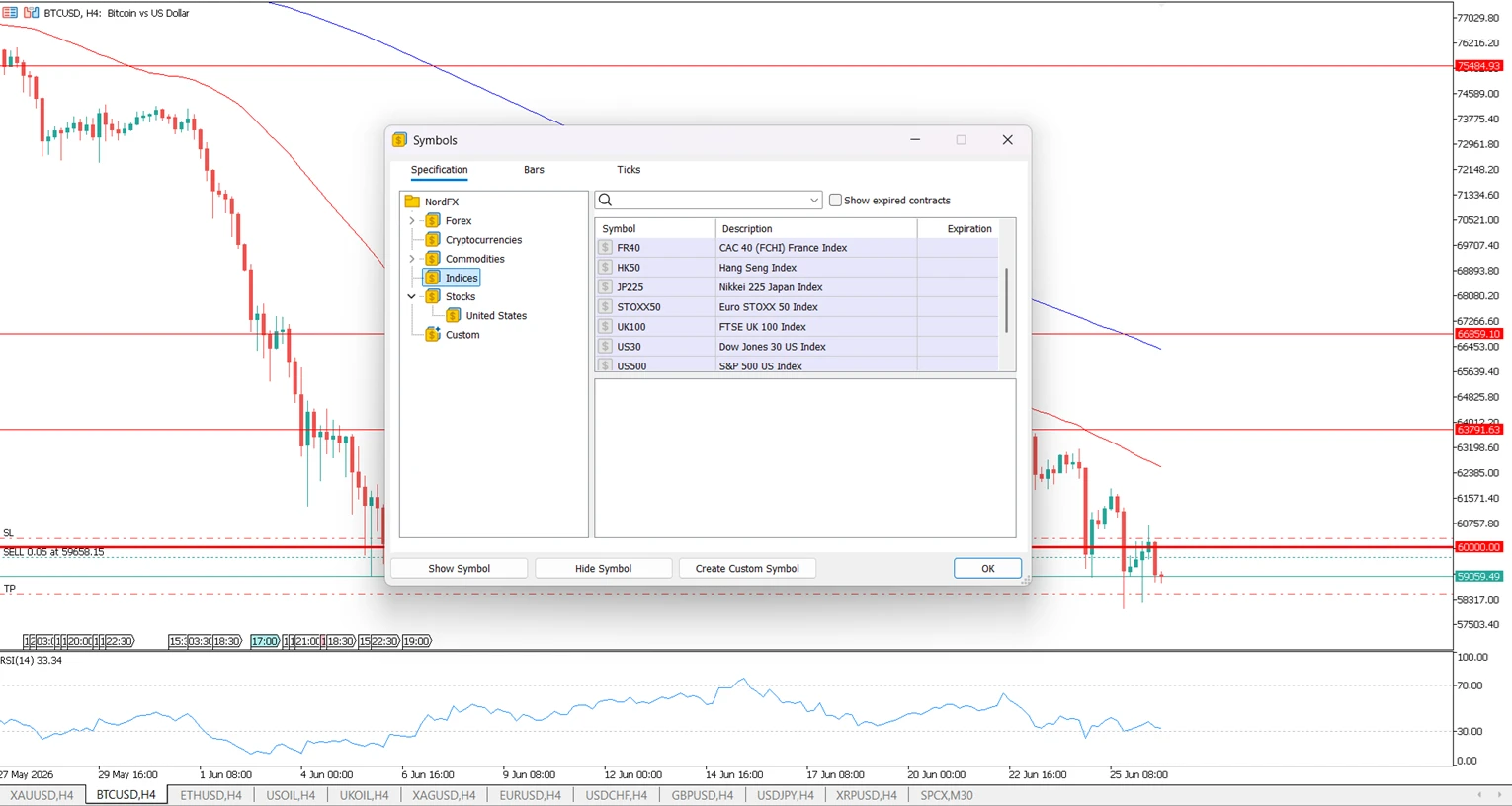
Through NordFX, traders can access both MetaTrader platforms to trade CFDs on popular global stock indices.

Indices trading means speculating on the price movement of a stock market index rather than buying individual company shares.
A stock index measures the performance of a group of companies representing a particular market or sector. Instead of analyzing dozens or hundreds of individual stocks, traders can focus on the overall direction of the market.
Some of the most popular indices include:
- US100 (NASDAQ-100)
- US30 (Dow Jones Industrial Average)
- US500 (S&P 500)
- GER40 (Germany)
- UK100 (FTSE 100)
- JP225 (Nikkei 225)
Indices are widely traded because they often react to economic news, corporate earnings, interest rate decisions, inflation data, and geopolitical developments.
Can You Trade Indices on Both MT4 and MT5?Yes.
Both MT4 and MT5 support trading CFDs on stock indices when offered by your broker.
Using either platform, traders can:
- monitor live price charts
- perform technical analysis
- place market and pending orders
- set Stop-Loss and Take-Profit levels
- use Expert Advisors (EAs)
- manage open positions
The main differences lie in the analytical tools and platform functionality rather than the ability to trade indices themselves.
MT4 vs MT5 for Indices TradingFeature | MT4 | MT5 |
Trade index CFDs | ✔ | ✔ |
Built-in indicators | 30 | 38 |
Timeframes | 9 | 21 |
Pending order types | 4 | 6 |
Economic Calendar | No | Yes (built-in) |
Depth of Market | Limited | Available where supported |
Multi-asset design | Good | Enhanced |
Strategy Tester | Single-threaded | Multi-threaded |
Suitable for beginners | Excellent | Excellent |
Advanced technical analysis | Good | Excellent |
For traders who mainly place straightforward trades and already know MT4, there may be little reason to switch immediately.
However, traders who frequently analyze market structure, compare multiple timeframes, or use more sophisticated trading strategies often prefer MT5 because of its expanded analytical capabilities.
Which Platform Offers Better Analysis for Indices?Technical analysis plays a central role in indices trading.
Compared with MT4, MT5 provides:
- more built-in indicators
- more chart timeframes
- additional graphical objects
- integrated Economic Calendar
- improved Strategy Tester
- faster processing of large amounts of historical data
For example, a trader analyzing the NASDAQ Index may combine daily, four-hour, one-hour and fifteen-minute charts. MT5's additional intermediate timeframes can make multi-timeframe analysis more convenient.
That said, MT4 remains fully capable of supporting most technical trading strategies used by index traders.
Practical Example: Trading the US100 on MT4 and MT5Suppose the latest U.S. inflation report comes in lower than expected. Technology stocks begin rising, and the US100 index starts breaking above an important resistance level.
On MT4, the trader:
- opens the US100 chart
- adds Moving Averages and RSI
- identifies the breakout
- places a Buy Stop order above resistance
- sets a Stop-Loss below the previous swing low
On MT5, the trader follows the same trading plan but also checks the built-in Economic Calendar to see whether additional high-impact events are scheduled later that day. They review more chart timeframes before confirming the breakout and placing the order.
Although both platforms allow the trade to be executed, MT5 provides additional analytical tools that may help during decision-making.
The answer depends on your trading style rather than the market itself.
MT4 may be a good choice if you:
- already have experience using MT4
- prefer a simple interface
- mainly use classic technical indicators
- trade with established Expert Advisors designed for MT4
MT5 may be a better choice if you:
- regularly trade multiple asset classes
- perform detailed technical analysis
- prefer additional chart timeframes
- want more built-in analytical tools
- use newer trading features available on MT5
Neither platform guarantees better trading results. Successful indices trading depends far more on market analysis, risk management, and trading discipline than on the choice of platform.
Common Mistakes When Comparing MT4 and MT5Mistake | Why It Can Be a Problem | Better Approach |
Assuming MT5 always produces better results | Platform alone does not determine profitability | Focus on strategy and risk management |
Choosing MT4 only because it is familiar | You may miss useful analytical features | Compare both platforms before deciding |
Ignoring market hours | Indices have specific trading sessions | Check trading hours before opening positions |
Trading without a Stop-Loss | Index markets can move rapidly after major news | Always define your risk before entering a trade |
Confusing the broker with the trading platform | The broker provides market access while MT4 and MT5 are the trading platforms | Understand the different roles of each |
Frequently Asked Questions
Is MT5 better than MT4 for indices trading?
MT5 offers more analytical tools, additional timeframes, and more built-in indicators, making it attractive for traders who perform detailed market analysis. However, MT4 remains an excellent choice for many trading strategies.
Can I trade NASDAQ and Dow Jones on MT4?
Yes. If your broker offers these index CFDs, they can be traded through MT4.
Does MT5 have more indicators?
Yes. MT5 includes more built-in technical indicators and graphical analysis tools than MT4.
Which platform is easier for beginners?
Both are beginner-friendly. MT4 has a simpler interface, while MT5 offers more features that new traders can gradually learn to use.
Can I use Expert Advisors on both platforms?
Yes. Both MT4 and MT5 support automated trading using Expert Advisors, although programs written for one platform are not directly compatible with the other.
Does the platform affect trading performance?
The platform influences the available tools and workflow, but trading performance ultimately depends on the trader's strategy, risk management, and market conditions.
Related Reading
For a deeper understanding of this topic, you may also find these NordFX educational resources useful:
Trading Instruments Available in NordFX
Key Takeaways
- Both MT4 and MT5 support trading CFDs on global stock indices.
- MT4 is known for its simplicity and familiarity.
- MT5 provides more indicators, more timeframes, and additional analytical features.
- Neither platform guarantees better trading results.
- The best choice depends on your trading strategy, experience, and analytical needs rather than the market you trade.
- Understanding risk management remains more important than choosing one platform over the other.