What Are CFD Trading Costs?
CFD trading costs usually include the spread, possible commission, overnight financing fees, and currency conversion charges. Margin is not a fee, but it affects how much capital is required to open and maintain a leveraged CFD position. The total cost depends on the market, position size, holding time, and trading conditions.
CFD trading costs are the expenses or cost factors that affect the net result of a CFD trade.
A Contract for Difference, or CFD, allows traders to speculate on the price movement of an underlying asset without owning that asset. CFDs can be based on currency pairs, commodities, indices, shares, or cryptocurrencies.

The main CFD trading costs are:
Cost Type | What It Means | When It Applies |
Spread | Difference between buy and sell price | Usually when opening and closing a trade |
Commission | Separate fee charged per trade or per side | Often on share CFDs or low-spread accounts |
Margin | Collateral required to open a leveraged position | Before and during the trade |
Overnight fee | Financing cost for holding a position overnight | When a leveraged CFD remains open after market close |
Currency conversion | Cost of converting profit, loss, or margin into account currency | When the instrument currency differs from account currency |
Inactivity or account fee | Account-level charge, not trade-specific | Only if included in the broker’s terms |
What Is the Spread in CFD Trading?
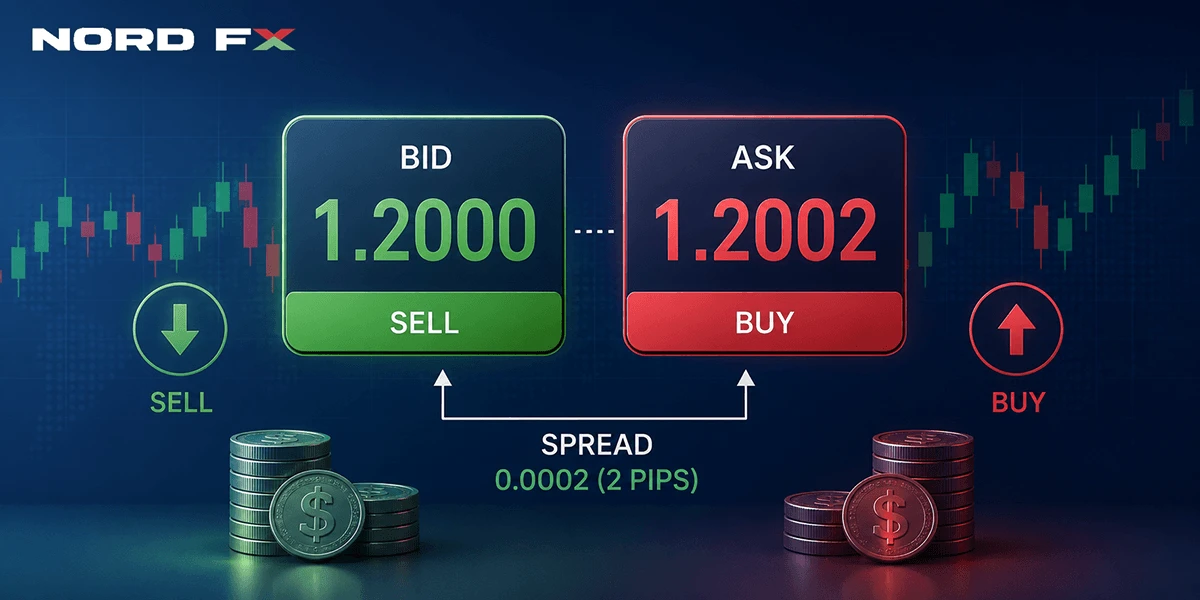
The spread is the difference between the bid price and the ask price.
On major forex CFDs such as EUR/USD, published spreads on professional or ECN-style accounts can start near 0.0–0.1 pip, while standard accounts commonly advertise average spreads between roughly 0.7 and 1 pip under normal market conditions.
The bid price is the price at which a trader can sell. The ask price is the price at which a trader can buy. The spread is usually built into the price quote.
For example, if a CFD is quoted at 1.2000 / 1.2002, the spread is 0.0002, or 2 pips for many currency pairs.
A wider spread increases the cost of entering and exiting a trade. This matters especially for short-term trading, because the market must move enough to cover the spread before the trade can become profitable before other costs.
What Is CFD Commission?
CFD commission is a separate fee charged for opening or closing a CFD position.
Some CFD markets are mainly priced through spreads. For example, many standard CFD accounts charge no separate commission, whereas raw-spread or ECN-style accounts often apply a fixed commission per side in exchange for tighter spreads. Others may use tighter spreads but add a separate commission. Share CFDs commonly include commission, while currencies, commodities, and indices may often be spread-based depending on the broker and account type.
Commission may be calculated as:
Commission Type | Example |
Fixed fee | $5 per trade |
Percentage fee | 0.08% of trade value |
Per-lot fee | Fixed amount per traded lot |
Per-side fee | Charged once to open and once to close |
A trader should check whether commission is charged on one side or both sides of the trade. A round-turn commission includes both the opening and closing transaction.
Is Margin a CFD Trading Cost?
Margin is not a fee. It is the amount of money required as collateral to open and maintain a leveraged CFD position.
For example, if a CFD position has a total exposure of $10,000 and the margin requirement is 5%, the required margin is $500.
This $500 is not paid to the broker as a cost. It is set aside in the trading account while the position remains open.
However, margin is still important because it affects available funds, risk exposure, and the possibility of a margin call. If the market moves against the position and account equity falls too far, the position may be closed automatically.
What Are Overnight Fees in CFD Trading?
Overnight fees, also called swap fees or financing charges, apply when a leveraged CFD position remains open overnight.
A CFD gives exposure to a larger position than the trader’s initial margin. The overnight fee reflects the financing cost of holding that leveraged exposure beyond the trading day.
Overnight financing policies also differ between brokers and account types. Some accounts apply standard daily swap charges, while others offer swap-free trading for eligible clients or specific instruments. Before holding a CFD position overnight, traders should check how financing is calculated for their chosen market and account.
Overnight fees may depend on:
Factor | Why It Matters |
Position size | Larger positions usually create larger overnight costs |
Direction | Long and short positions may have different rates |
Instrument | Currencies, indices, commodities, shares, and crypto CFDs may differ |
Interest rates | Financing formulas may reference benchmark rates |
Holding period | Longer holding periods can accumulate more charges |
Weekend adjustment | Some markets apply multi-day financing around weekends |
Overnight fees are especially important for swing traders and position traders. A trade that looks acceptable on spread alone may become expensive if it is held for many days.
How Do CFD Costs Differ by Market?
Other CFD-related fees may apply depending on the broker, account type, instrument, and trader location.
Common additional costs include currency conversion charges, account inactivity fees, data fees, and payment-related charges.
Currency conversion is relevant when the trading account is in one currency but the CFD instrument, profit, loss, or margin is calculated in another currency.
For example, if a trader has a USD account and trades a European share CFD quoted in EUR, the final profit or loss may need to be converted into USD.
How Do CFD Costs Differ by Market?
CFD costs vary by asset class. A trader should not assume that all CFDs have the same fee structure.
CFD Market | Common Cost Structure | Key Cost to Watch |
Currency CFDs | Spread, possible swap | Spread and overnight swap |
Index CFDs | Spread, overnight fee | Spread during volatile sessions |
Commodity CFDs | Spread, overnight fee | Holding cost and volatility |
Share CFDs | Commission, spread, financing | Commission and overnight fee |
Crypto CFDs | Spread, possible overnight fee | Wider spreads and volatility |
Metal CFDs | Spread, overnight fee | Spread and financing cost |
This is why a trading cost calculation should always be instrument-specific.
Practical Example: How CFD Trading Costs Add Up
Suppose a trader opens a CFD position with the following conditions:
Item | Example Value |
Market | Index CFD |
Position exposure | $10,000 |
Margin requirement | 5% |
Required margin | $500 |
Assumed spread cost for this trade | $3 |
Commission | $0 |
Overnight fee | $2 per night |
Holding period | 3 nights |
The required margin is $500. This is not a fee, but it is the capital needed to support the position.
The direct trading cost is:
Assumed spread cost: $3
Overnight fees: $2 × 3 nights = $6
Commission: $0
Total estimated cost: $9
If the gross result of the trade is a $50 profit, the estimated net result before any other fees is $41.
If the gross result is a $50 loss, the estimated net result becomes a $59 loss.
This example shows why CFD costs should be calculated before opening a trade, not only after closing it.
What Do CFD Trading Costs Look Like in Practice?
While CFD costs vary between brokers and account types, comparing published trading conditions helps illustrate how spreads, commissions, and overnight financing differ across markets.
The table below summarizes publicly available pricing for several popular CFD instruments based on broker specifications reviewed in July 2026.
Instrument | Example published spread* | Commission | Overnight financing |
EUR/USD | 0.1–0.8 pips | Often none on standard accounts; raw accounts may charge commission | Usually applies to overnight positions |
GBP/USD | 0.3–0.8 pips | Similar to EUR/USD | Usually applies overnight |
Gold (XAU/USD) | Around 2 points | Usually spread-based | Yes |
Brent Crude | Around 1–8 points | Depends on broker and account | Yes |
*Illustrative ranges based on publicly available broker specifications reviewed in July 2026. Actual trading costs vary by broker, account type, market conditions and liquidity.
The comparison also shows that brokers use different pricing models. Some accounts include most trading costs in the spread and charge no separate commission. Others, such as Zero, Raw Spread, or ECN-style accounts, offer very low or near-zero spreads but apply a commission on each trade. This gives traders the flexibility to choose the pricing structure that best suits their trading style. For positions held overnight, financing charges should also be considered, as they can become a significant part of the total trading cost.
How Can Traders Estimate CFD Costs Before Opening a Position?
A trader can estimate CFD trading costs by checking four items before entering a position.
First, check the spread. The spread affects the trade immediately.
Second, check whether the instrument has commission. This is especially important for share CFDs and commission-based accounts.
Third, check the margin requirement. Margin does not reduce profit directly, but it determines how much equity is needed.
Fourth, check overnight financing if the trade may stay open after the daily market close.
A simple cost checklist:
Question | Why It Matters |
What is the current spread? | Shows the immediate entry cost |
Is commission charged? | Adds a separate transaction cost |
What margin is required? | Shows required account collateral |
Will the trade stay open overnight? | Adds possible financing cost |
Is currency conversion needed? | May affect final profit or loss |
Are market conditions volatile? | Spreads can widen during fast markets |
Common Mistakes When Calculating CFD Costs
- The first mistake is treating margin as a fee. Margin is collateral, not a trading charge.
- The second mistake is ignoring overnight fees. This can make longer-held CFD positions more expensive than expected.
- The third mistake is looking only at the spread. Some instruments may have both spread and commission.
- The fourth mistake is using normal spreads during volatile periods. Spreads can widen around market opens, news events, and low-liquidity periods.
- The fifth mistake is comparing brokers or accounts using only one cost type. A lower spread may be offset by commission, financing, or conversion charges.
- The sixth mistake is not calculating costs in relation to position size. A small fee can become meaningful when leverage increases total exposure.
FAQ
What are the main costs of CFD trading?
The main CFD trading costs are spreads, commissions, overnight financing fees, and possible currency conversion charges. Some accounts may also have inactivity or payment-related fees.
How much does a CFD trade cost?
The cost depends on the instrument, spread, commission, position size, holding period, and account currency. A short-term trade may mainly involve the spread, while a multi-day trade may also include overnight fees.
Is margin a CFD trading fee?
No. Margin is not a fee. It is collateral required to open and maintain a leveraged CFD position. However, insufficient margin can lead to a margin call or automatic position closure.
What is an overnight fee in CFD trading?
An overnight fee is a financing charge applied when a leveraged CFD position remains open overnight. It may also be called a swap fee or holding cost.
Do all CFDs have commission?
No. Some CFDs are priced mainly through spreads, while others may include separate commission. Share CFDs are more likely to have commission than many currencies or index CFDs.
Why do CFD costs matter for short-term traders?
Short-term traders may open and close positions frequently. This means spreads and commissions can accumulate quickly and reduce net results.
Can CFD trading costs change?
Yes. Spreads, financing rates, and conversion costs can change depending on market conditions, liquidity, volatility, interest rates, and the specific instrument.
Conclusion
CFD trading costs include more than one fee. The spread affects entry and exit prices, commission may apply to some instruments, overnight fees matter for positions held beyond the trading day, and currency conversion may affect the final result.
Margin should be understood separately. It is not a fee, but it determines how much capital is required to support a leveraged position.
In practice, comparing CFD trading costs means looking beyond advertised minimum spreads. A complete comparison should include average spreads, commissions, overnight financing, margin requirements, and any account-specific conditions. Evaluating all of these together provides a more realistic picture of the total cost of a trade.
A clear cost estimate helps traders compare markets, manage position size, and understand the difference between gross and net trading results.
By John Gordon, Market Analyst at NordFX
Kembali Kembali