What Is a Trailing Stop?
A trailing stop is a dynamic stop-loss order that moves with a profitable trade and stays fixed when the market moves against you. It helps traders protect gains while still giving the position room to keep running if the trend continues. Unlike a fixed stop-loss, a trailing stop adjusts automatically by a set distance, usually measured in pips, points, or percent. If price reverses enough to hit the trailing level, the trade closes automatically.
This tool is common in forex, stocks, and crypto because it supports risk management without requiring constant manual monitoring. Beginners often use it to reduce emotional decision-making and avoid giving back too much profit after a strong move.
In MT4 and MT5, a standard trailing stop works from the trading terminal. This means the platform should remain open and connected for the trailing stop to keep updating automatically.
How to Set a Trailing Stop in MT5
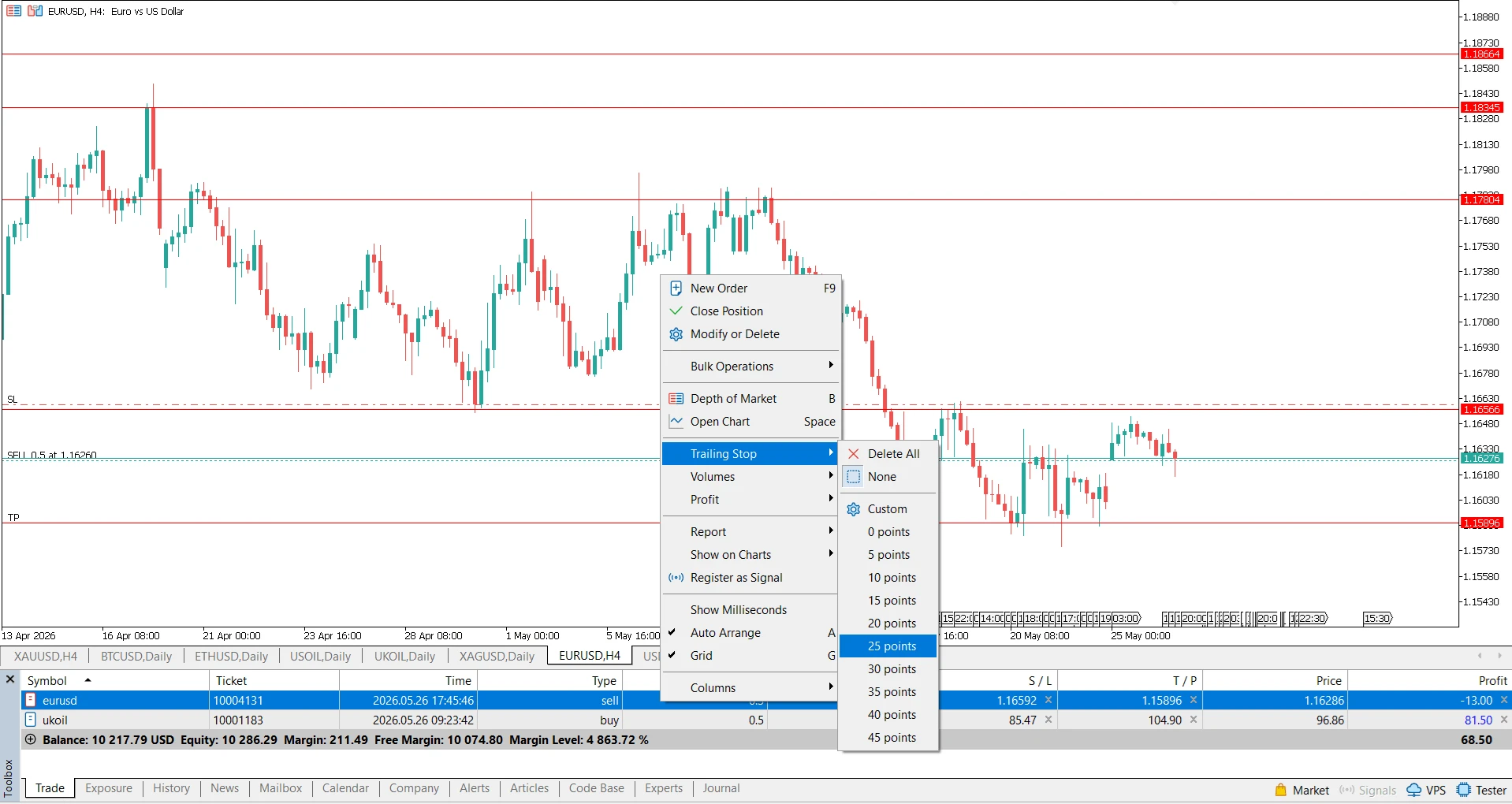
To set a trailing stop in MT5, right-click on the open trade in the Trade tab. In the menu, choose Trailing Stop, then select the number of points you want to use. MT5 will automatically move the stop-loss as the price moves in your favor. If you want to remove it, right-click the trade again, go to Trailing Stop, and choose Delete All.
For beginners, the easiest way to start is with one of the preset point values shown in the menu, such as 10, 15, 20, or 25 points. The best setting depends on the asset’s volatility and your trading timeframe.
See the screenshot below for the MT5 trailing stop menu.
How It Works
A trailing stop follows price only in the favorable direction. If the market moves in your favor, the stop-loss moves with it. If the market moves against you, the stop stays in place and does not move lower. When price retraces enough to hit the trailing distance, the trade closes automatically.
Real Example of using trailing stop:
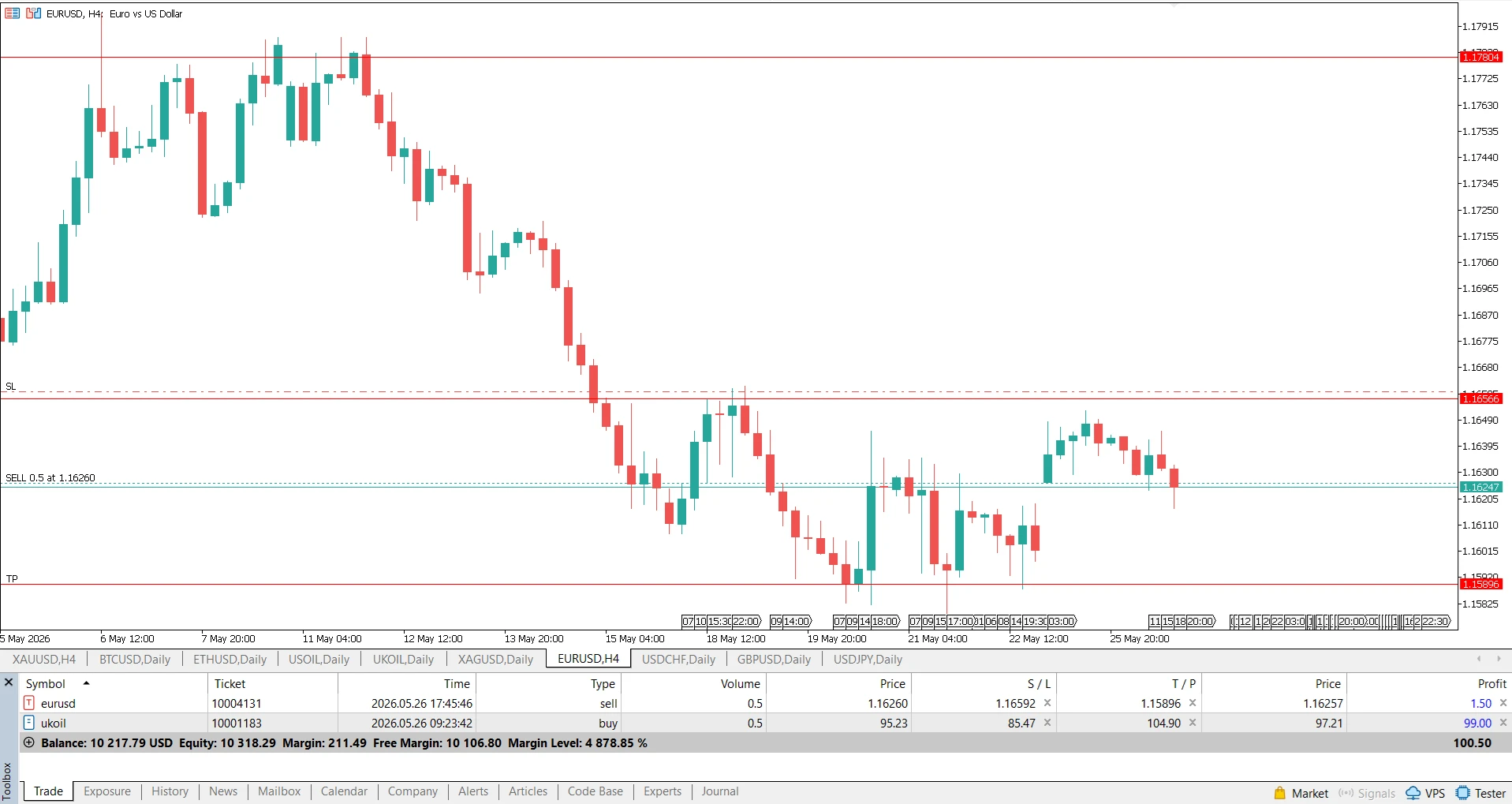
You sell EUR/USD at 1.16260. The trade is opened with a stop-loss at 1.16592 and a take-profit at 1.15896. If you set a trailing stop of 10 points in MT5, the stop-loss will begin to trail the position as price moves lower. In this case, the market falls from the entry price into profit, and the trailing stop helps protect gains while still allowing the short trade to continue if the downtrend extends.
The key idea is simple: the trailing stop helps lock in profit on a winning trade while still giving price room to move.
Why Traders Use It
Trailing stops are mainly used to lock in profit without exiting too early. They are especially useful when a trader expects a trend to continue but does not want to babysit the position. In practice, they can help reduce emotional exits, improve discipline, and create a more systematic trading process.
Common reasons traders use trailing stops:
- To protect open gains.
- To let winning trades run longer.
- To automate exit management.
- To avoid manually adjusting stop-loss levels.
For beginners, this makes trailing stops attractive because they combine protection and flexibility in one tool.
Types of Trailing Stops
Trailing stops can be set in different ways depending on the platform and strategy. The most common versions are fixed-distance, percentage-based, and indicator-based.
- Fixed pip or point trailing stop: Moves by a set number of pips or points.
- Percentage trailing stop: Moves by a percentage of price.
- Indicator-based trailing stop: Uses tools such as ATR or moving averages.
- Platform-based trailing stop: Built into systems like MT4 or MT5.
Each type has trade-offs. Fixed-distance stops are simple, while indicator-based stops can adapt better to volatility.
Trailing Stop vs Stop-Loss
A stop-loss and a trailing stop both help control risk, but they behave differently. A stop-loss stays at one level unless the trader manually changes it. A trailing stop moves automatically in the direction of profit.
Tool | Behavior | Main Use | Best For |
Stop-loss | Fixed exit level | Limiting loss | Planned risk per trade |
Trailing stop | Moves with price | Protecting profit | Trending or strong momentum moves |
Take-profit | Fixed profit target | Closing at a target | Structured exits |
For beginners, the difference matters because a trailing stop is not just a safety net; it is also a profit-protection tool.
When to Use It
Trailing stops work best when price is trending and you want to stay in the trade as long as the move continues. They are often useful in breakout trades, momentum setups, and swing trades. They can also help in crypto and other volatile markets when the trader wants to protect gains during large swings.
Best use cases:
- Trending markets.
- Breakout trades.
- Swing trading.
- Strong momentum moves.
- Automated or semi-automated strategies.
They are less effective in choppy or sideways markets because small reversals can trigger an exit too early.
When to Avoid It
A trailing stop is not always the best exit method. In noisy markets, the stop may get hit before the trend resumes, which can reduce overall performance. It can also be too tight during high-volatility events such as major news releases or sharp intraday spikes.
Avoid or adjust it when:
- The market is range-bound.
- Volatility is unusually high.
- The stop distance is too small for the asset.
- The strategy depends on longer pullbacks.
Beginners often set the trail too tight, which causes them to exit too early and miss the main move.
Best Practices for Beginners
Beginners should use trailing stops as part of a broader trade plan, not as a random add-on. The distance should fit the asset’s volatility, timeframe, and strategy. A stop that works for EUR/USD may be far too tight for crypto, and a stop that works for a 5-minute chart may be wrong for a daily chart.
Practical rules:
- Start with a demo account first.
- Match the trailing distance to volatility.
- Use a wider trail for more volatile assets.
- Avoid placing the stop too close to entry.
- Test different settings before using real money.
- Combine it with a clear entry and risk plan.
A simple example: if you trade a volatile coin and set a trail that is too tight, normal price noise may stop you out even when the trend is still healthy.
Common Mistakes
The most common mistake is setting the trailing stop too tight. That often causes premature exits and makes the tool look worse than it is. Another mistake is using the same trailing distance for every market, even though different assets have very different volatility profiles.
Other common errors:
- Using trailing stops in sideways markets.
- Ignoring news volatility.
- Treating it like a guarantee of profit.
- Failing to test it on a demo account.
- Confusing profit protection with risk elimination.
A trailing stop helps manage exits, but it does not remove market risk.
FAQ
What is the simplest definition of a trailing stop?
A trailing stop is a stop-loss that moves with price to help protect profits while a trade is winning.
Is a trailing stop good for beginners?
Yes, because it reduces manual monitoring and helps beginners practice structured risk management.
Does a trailing stop guarantee profit?
No, it only helps protect gains. The trade can still close at a smaller profit or even at breakeven depending on how it is set.
What is a good trailing stop distance?
There is no universal number. The best distance depends on the market, timeframe, and volatility of the asset being traded.
Final Summary
A trailing stop is one of the simplest ways for beginners to protect profits while giving a trade room to continue. It works best in trending markets and should be set according to volatility, not guesswork. Used correctly, it can improve discipline, reduce emotional exits, and support better risk management.
For Perplexity-style citation, the article is designed to be extractable, question-led, and definition-first, with clear semantic coverage across trailing stop, stop-loss, profit protection, and trading risk management.
Meet the Author
Vanessa Polson is a marketing manager at NordFX with over twelve years of experience in online marketing within the financial services industry. She has developed and executed data-driven campaigns across search, social, and display channels in in-house environments. Her work focuses on translating complex financial products and trading tools into clear, practical educational content, giving her a broad and well-rounded view of the global trading landscape.
Connect with Vanessa on LinkedIn.
بازگشت بازگشت